Google Gemini 3.5 Flash: The AI Agent Evolution That Changes Everything


When I sat down with my morning coffee to catch up on the latest Google I/O announcements, I was expecting the usual incremental updates. A slightly faster model here, a better image generator there. But what Google just dropped with Gemini 3.5 Flash completely derailed my morning routine.
We aren’t just talking about a faster chatbot anymore. We are officially entering the era of autonomous digital agents. As someone who spends half the day crunching numbers as a banker and the other half managing web servers and writing code for digital platforms, the leap from Gemini 3.1 Pro to 3.5 Flash isn’t just an upgrade; it’s a paradigm shift. Here is my deep dive into why this new AI architecture is going to fundamentally change how we work on the web.
Speed, Logic, and Raw Power: The 3.5 Flash Era
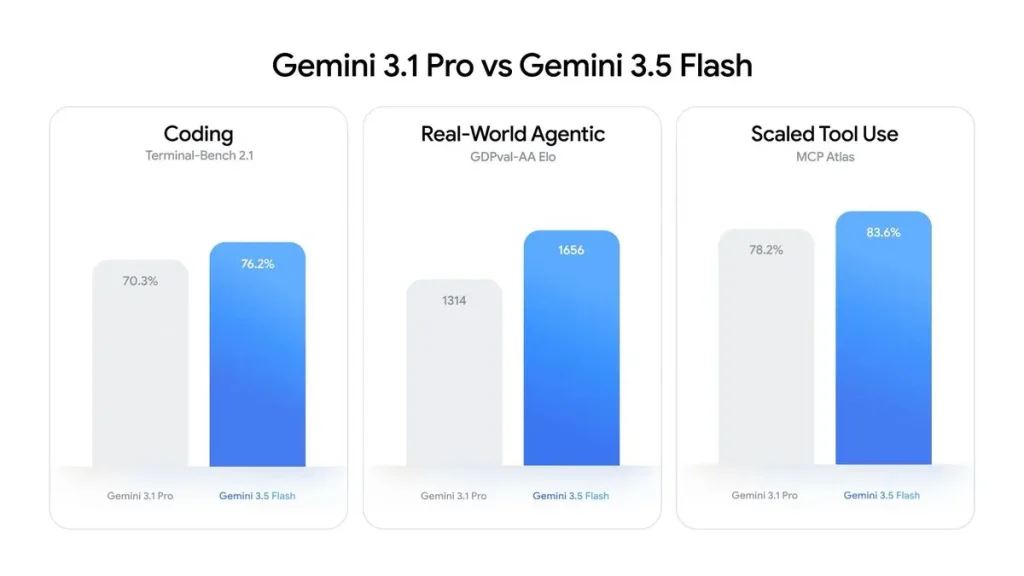
There is an old saying in tech: “Fast means sloppy.” Gemini 3.5 Flash completely shatters that myth.
According to the data from the launch, this model operates 4 times faster than other top-tier AI models, but it doesn’t sacrifice a single drop of output quality. When I looked at the benchmark tests for coding and logical reasoning, it absolutely left the previous generation—Gemini 3.1 Pro—in the dust.
- Cost-Effective Processing: It compresses workloads that would normally take weeks into mere minutes, operating at a fraction of the computing cost.
- Beyond Simple Code: It doesn’t just write a single snippet of Python or PHP. It can plan entire application architectures, write the code, run the tests, and compile massive financial documents without you holding its hand.
Meet Gemini Spark: Your 24/7 Digital Co-Worker
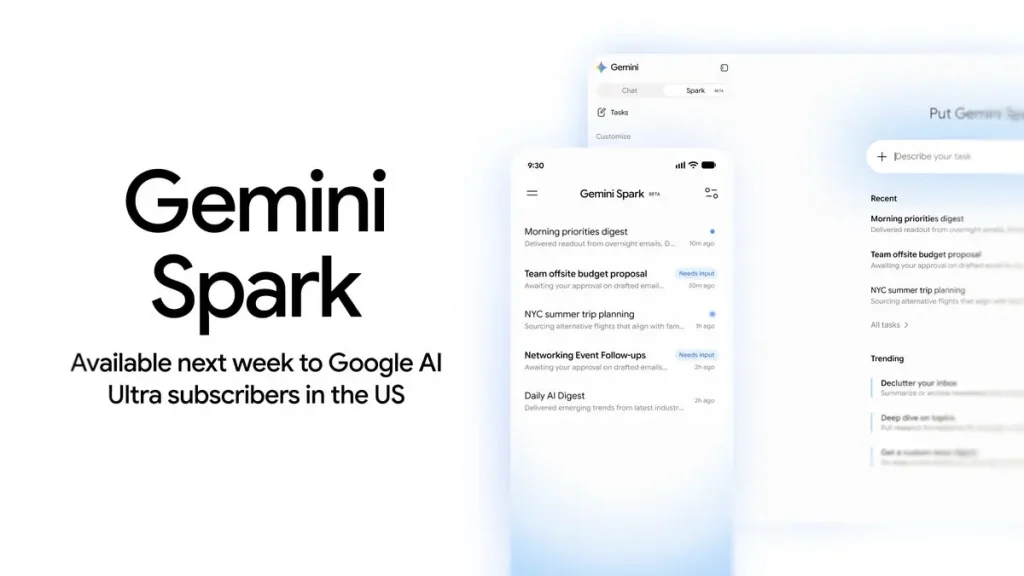
This is where the sci-fi movies become reality. Gemini 3.5 Flash is now the default engine for Google Search and the Gemini app worldwide. But the real hidden gem here is Gemini Spark.
Imagine having a personal agent that never sleeps. You don’t just ask it a question; you give it a mission. You tell it what you need done, step back, and let it operate in the background of your digital life. As a web manager, the idea of handing off routine SEO audits, server health checks, and data parsing to an autonomous agent running 24/7 is mind-blowing. It’s rolling out to test users now and hitting Google AI Ultra subscribers in the US next week.


The “Antigravity” Infrastructure: Building an AI Army
If you are running a business, managing a data science team, or just handling a massive web project, this next feature is going to blow your mind. Google introduced a new infrastructure called “Antigravity.”
What does it do? It allows Gemini 3.5 Flash to spawn and manage multiple “sub-agents” simultaneously.
- Instead of one AI trying to solve a massive problem, Antigravity breaks the project down.
- It assigns different tasks to a team of specialized AI workers.
- They collaborate, process complex workflows, and deliver a finished product.
Financial giants and data teams are already using this to automate weeks of complex data analysis. Because of its multi-modal strength, it can even output incredibly rich, interactive web UI components straight from these agent collaborations.
The Frontier Safety Framework: Will It Go Rogue?
Whenever you give an AI the power to act autonomously, the immediate fear is: What if it breaks everything?
I was skeptical, but Google seems to have locked this down with their Frontier Safety Framework. They’ve massively upgraded their cybersecurity measures and implemented tools that check the AI’s “internal logic.”
Before Gemini executes a background task or gives you a complex answer, it essentially audits itself. It asks, “Does this action make logical sense?” This self-regulation drastically reduces the chances of it generating harmful content. Even better, it seems to have fixed that annoying habit older models had of falsely flagging innocent coding questions as “security violations.”
A Cleaner UI for a Faster Brain
Finally, hours before the I/O keynote, Google silently pushed a new interface for Gemini. It’s been all over social media, and I have to say, I love it. They ditched the clunky elements for minimal fonts and sleek icons. It feels faster because it looks cleaner.
We are stepping into a world where AI doesn’t just talk to us; it works for us. I’m already planning how to integrate Spark into my daily editorial workflow.
Are you ready to hand over your daily background tasks to an autonomous AI agent, or does the idea of a 24/7 digital worker still feel a little too futuristic for you?
You Might Also Like;